When I grow up I want to be an artist like Jon. Check out his passion and craftsmanship so beautifully captured in this video. Then, browse through his portfolio here. Cheers, Mandy
Jon Contino from Kevin Steen on Vimeo.

Showing posts with label artisan process. Show all posts
Showing posts with label artisan process. Show all posts
Saturday, December 8, 2012

Monday, May 14, 2012
my woad weekend
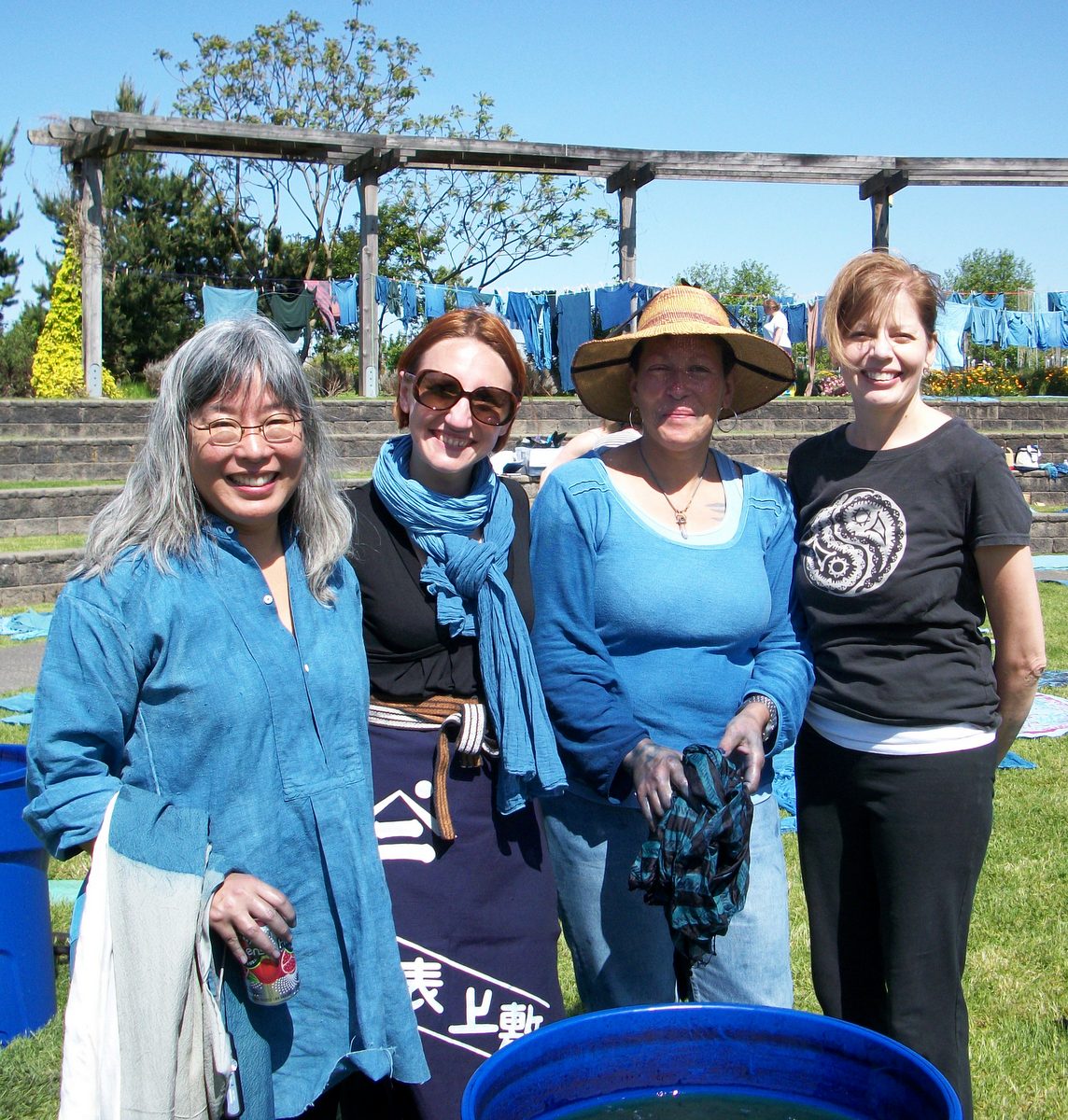
Kathy Hattori, Sophie Boss, Denise Lambert, me
For those of you who missed it, I previously blogged about my obsession with woad here: "mad about woad". I find this "black blue" to be exquisite and cannot wait to use my freshly dyed fabrics (and woad oil paints I purchased from Bleu online) for some upcoming art projects.
According to Denise, woad is a very rare blue that is finicky and demands a lot of patience. It is earth-friendly (requires no mordant) and uses oxygen to complete the color transformation. To achieve a uniform dye color, one must slowly lower the item into the dye vat so as to avoid trapping any air (oxygen) bubbles underneath the surface. Each dip takes anywhere from 3-4 minutes and each item should get at least 2 dips. My biggest challenge will be making my own vat at home -- wish me luck!
Watching the color transformation of the garments as they were being pulled from the various vats in the amphitheater was purely magical. I will try to post the video I captured of one woman's sarong as it changed from yellow-green to vibrant woad.
Perhaps the most important takeaway from the day was something Denise said about working with woad: "You must accept what you receive". What an amazing way to approach life, don't you think?

Woad treasures from the morning session.

Dyed items were hung on makeshift clothes lines at the top of the garden amphitheater which made for a beautiful sight.

Sophie + Denise restocking the vats at lunch time

I experimented with dying my spool of 100% organic cotton thread. I knew the under layers wouldn't dye, but all the better.

Yarn skeins and canvas shoes of woad blue.
In closing, the workshop was a dream! The weather couldn't have been better, I got to "play" alongside other artists, and I walked away with a hefty bundle of woad-dyed textiles, some for wearing and some for future art projects. One thing's for sure, it was the perfect way to kick start my Mother's Day weekend. Cheers!
Saturday, December 17, 2011
taking the mother road -- the first story
NOTE: This post was originally published on August 29, 2011.
 "Taking the Mother Road" - limited edition giclée print
Please allow me to share a story for each of the six paintings from my Dust Bowl Glimpses series, my first in some years now. They are dedicated to the impoverished people who, despite hardship, extended a hand to help strangers because it was the humane thing to do.
The first, "Taking the Mother Road", sets the stage for the remaining five:
They didn’t want to leave but they had no choice. Drought, dying livestock, foreclosures, and acres of topsoil blown into their homes and lungs drove them away from the only life they knew. California offered promises of steady work and fertile ground—a fresh start. They were taking the mother road.
 "Taking the Mother Road" - 8"x8" acrylic on cradled wood panel
The colors are intentionally-muted. The landscape appropriately desolate. "Taking the Mother Road" attempts to capture the constant migration of families.
One by one, impoverished families of the Dust Bowl (1930s America) crawled onto Route 66, the mother road, in search of a better living out West. While some families stayed put, most could no longer endure the merciless conditions created by what would become a record-breaking 10-year drought, uncultivable land, and devastating winds that blew an estimated 100 million acres of topsoil across the region into homes, schools, and townships. One storm no dust bowler ever forgot was “Black Sunday”, a debilitating dust storm on April 14, 1935, that rolled across Kansas, Oklahoma, New Mexico, Colorado, and Texas.
My research on this project involved:
- Reading John Steinbeck's Pulitzer-prize winning novel The Grapes of Wrath
- Listening to my mom share stories of our ancestors who homesteaded on the prairies of Kansas and Colorado during the 1930s
- Viewing PBS' American Experience (love their whole body of work) Surviving the Dust Bowl
- Viewing the government-sponsored documentary released in 1936 The Plow that Broke the Plains
- Visiting a variety of online sites
~~~~~~~~~~~~~~~~~~~~~~~~~~~~~~~~~~~~
Click here to read the stories on the remaining five DUST BOWL GLIMPSES paintings. Galleries have also been added to my Web site: www.weatheredsilo.com.
Sunday, October 16, 2011
keeping a promise to myself

This week I kept a promise to myself: I made time to work on my "Art is My Compass" project. It wasn't easy given my chaotic parenting and volunteering schedule, but, like I've said before, without art I am lost.

I've experimented with staining art papers with coffee, tea, and wine. I'm most happy with the uneven edges of the stain and I'm really digging the use of pencil and ink. I like to think that my great-grandmothers would approve of the use of natural colorants to create my art -- I've heard stories they, too, used coffee to dye fabric.

I've added a number of photos to my new flickr account. You are more than welcome to take a peek. Cheers, Mandy
Saturday, September 3, 2011
faded clover - the sixth story

She never knew the likes of a store-bought dress. Neither did her three older sisters. Each migrant daughter wore clothes hand sewn by their mother, often times made from grain sacks. Her favorite was this clover-patterned number.

My mom's mom, Viola Davis, was born in 1926 in Hoxie, Kansas. Grandma was one of five children growing up in a small town on the northeastern plains Kansas during the Great Depression. She, like her siblings and so many children of that time, wore clothes beautifully hand sewn from flour and grain sacks--the inspiration for my painting.
Mom tells me how much my grandma adored the flour sack dresses her mom made. The clover-patterned number in my painting was a pattern I fell in love with during my research on the history of flour sack dresses. I like to believe that my grandma would approve of this painting.
Here is a photograph of my grandma, Viola Davis, in the early 1930s alongside two schoolmates. She is wearing one of the flour-sack dresses her mom made. I think she looks absolutely beautiful!
 My grandma, Viola Davis, and schoolmates in the early 1930s - Hoxie, KS
 "Faded Clover" - limited edition giclée print
 Thank you for allowing me to share stories about my Dust Bowl Glimpses paintings. Working on this collection has truly been a labor of love.
Cheers, Mandy
Friday, September 2, 2011
ruthie's red -- the fifth story

The colors of young Ruthie Joad’s world ranged from faded denims and soiled flesh to endless hues of brown. But that all changed when the rains finally came. The landscape was now littered with lush greens and vivid wildflowers. Ruthie grew particularly fond of red geraniums. They were now known as "Ruthie’s Red".

The moment I read how Ruthie Joad from The Grapes of Wrath stuck a petal from a "scraggly geranium gone wild" to her forehead because it resembled a heart, I knew I had to try and capture her euphoria on canvas. To me, this moment was not just a reprieve but also an escape to absolute normalcy for a child her age.


Tomorrow I will share a story of "Faded Clover", my sixth and final painting in my Dust Bowl Glimpses series. In case you missed them, here are stories one, two, three, and four. As always, thanks for stopping by. Cheers, Mandy
Thursday, September 1, 2011
fryin' pone -- the fourth story

This morning brought a welcome respite. The family awoke to the clattering of pans and the comforting aroma of ma’s homemade corn pone. Were they still dreaming, they wondered. Yesterday the men earned nearly a dollar pickin’ so ma could splurge on cornmeal and bacon at the camp store. Fryin’ pone made her feel decent again.


Packing up and leaving everything you know must have been petrifying for so many families on the road, especially the parents. Just imagine the strength it took to for mothers to carry on as if everything was going to be fine when in fact the future was uncertain. Thankfully there were moments where life resembled a time before the dust storms came. Moments like this where a mother could provide for her family. A moment when she could feel useful once again.
Thank you for following along as I share stories of my Dust Bowl Glimpses paintings. Here are links to stories one, two, and three of six.
And, before I forget, I wanted to make special mention of the stunning frame pictured with my giclées. It is beautifully handcrafted from olde growth pine by Margaux + Walter Kent of Peg+Awl. I couldn't imagine a more perfect pairing.
Cheers, Mandy
Wednesday, August 31, 2011
worldly possessions -- the third story

A mattress, some dishes, a stove if you were lucky enough to own one, definitely the tarpaulins, and maybe a chair or two. That was all they had room for on the truck besides the family. When you are a migrant family, these become your worldly possessions.


I knew almost immediately that I wanted to paint this image. To me, the sheer lack of belongings depicted in photograph after photograph of makeshift roadside camps spoke volumes about the plight of the migrant families. I hope you find beauty in the simplicity as much as I do.
Here are stories one and two of my Dust Bowl Glimpses paintings. As always, thank you for stopping by.
Mandy
Tuesday, August 30, 2011
waiting -- the second story

They’d driven as far as a dollar of gas could take them. Now they waited. Waited under the merciless sun with hungry bellies and soiled clothing. They waited for news of work in the fields as promised on government handbills distributed just weeks prior. They waited for a time when they were migrants no longer. Waiting was all they could do.


As a mother, I cannot imagine how difficult it must have been to raise a family under such dire conditions -- it certainly makes me appreciate the community, family, and home that I have today.
Part of my research for this painting involved tracking down the goods originally shipped in the cardboard box that Florence Owens Thompson sat on in Dorothea Lange's iconic Great Depression photograph, "Migrant Mother". Taking what little print I could see on the box, I finally tracked down this June 21, 1919 price list from Swift & Co. of their canned fish offerings (below). Don't you just love it?!


In case you missed it, here is the story of my first Dust Bowl Glimpses painting, "Taking the Mother Road". As always, thanks for stopping by. Cheers, Mandy
Tuesday, August 23, 2011
scumbling along

Earlier this year when I became too impatient for my oil paints to dry, I opted for acrylics (a medium I didn't have much experience with) to create my new Dust Bowl Glimpses paintings. And while I enjoyed how fast I was able to transfer my ideas to canvas using the acrylics, I was frustrated at how fast they dried.
I realize that there are products that can be mixed with acrylics to lengthen their drying times, but I wasn't interested in that option. So I began experimenting with acrylics and stumbled upon a painting technique called "scumbling".
What is scumbling? It involves applying a thin layer of opaque or semi-opaque paint over a layer of different color of paint. Scumbling may be achieved by scraping, scrubbing or dragging a layer of paint over a dark underpainting, resulting in a hazy, opalescent effect. Scumbling allows artists to create smooth transitions from light to dark and to modify the original color of the overlaid area without completely concealing it.
 Here I'm dragging a rather thick layer of raw sienna acrylic paint over a dried layer of paint.
 Here is the result. I LOVE it!
Here's a sneak peek at how I used scumbling on my "Fryin' Pone" painting that will be available for sale in my Etsy shop later this week alongside five other Dust Bowl Glimpses paintings. I'm thrilled to have turned a frustration into an opportunity. Cheers!
 Here I've scumbled a darker gray acrylic over a lighter gray to create depth on the metal spoon in my "Fryin' Pone" Dust Bowl Glimpses painting. I also scumbled a layer of deeper yellow ochre atop a dried lighter shade.
 Full view of "Fryin' Pone".
Friday, August 5, 2011
sustainable living: urnatur
I have an affinity for sustainable living. So do forester Håkan Strotz and his wife, biologist and designer Ulrika Krynitz. Together they've hand built a wooded retreat in Sweden named urnatur or "ancient nature."
This beautiful video, and others, can be found on the ANTHROPOLOGIST. Perhaps you, too, find the beauty in this video or the message they share.
My favorite quote from their story: "You can do it wherever. This is not a special forest. Go home and find your way to do it."
This beautiful video, and others, can be found on the ANTHROPOLOGIST. Perhaps you, too, find the beauty in this video or the message they share.
My favorite quote from their story: "You can do it wherever. This is not a special forest. Go home and find your way to do it."
Thursday, August 4, 2011
a recent discovery: the studio visit

The Studio Visit is a fantastic escape for those of us who enjoy discovering under exposed artists and how they produce their work. The site's Archives page is brilliantly designed: you can search work by artist, medium and region.
From their site:
"TheStudioVisit (TSV) introduces professional artists at work in their studios speaking directly to their work through a dialogue with the writer. This intimate first-person view into artistic process cultivates familiarity and appreciation of the intellectual and technical processes of contemporary art making. TheStudioVisit serves its audience as a welcoming place in which to discover newer or under exposed artists as well as artists who are crossing new thresholds in their work. It strives to engender nationwide networking among area artists as well as wider ranging art communities, connecting creators, curators, writers and patrons."
After viewing a few artist's videos, I'm already feeling a bit of validation that I can do this. As many of you know, I am a stay-at-home parent to two elementary-age daughters and I've only recently set up a studio in my home to resume painting and drawing following a lengthy hiatus. Clearly the responsibilities that come with the family and household take priority over studio time, however, seeing how other artists are able to "carve" out studio time in their daily lives is encouraging.
Here's Lily's studio visit. I love gaining the meaning behind an artist's body of work.
Lily Cox-Richard (M.S.) from Isabel Manalo on Vimeo.
Thursday, June 2, 2011
sneak preview no. 2
June is shaping up to be an exciting month for me. Here are just a few more images of what's to come later this month from my art studio. Have I mentioned my obsession with natural colorants and dyes? Cheers!
 canson cold-press 140 lb watercolor french paper I stained with my morning coffee for my "art is my compass" original art prints
 some of my colorado prairie landscape oil paintings on salvaged mexican hardwoods
 canson cold-press 140 lb watercolor french paper I stained with my morning coffee for my "art is my compass" original art prints


 some of my colorado prairie landscape oil paintings on salvaged mexican hardwoods
Thursday, February 3, 2011
an exquisite look at linen
Artists have painted on linen panels and canvasses for thousands of years. My research on the process of constructing these surfaces has inspired me to stretch my own canvas. I'm using organic linen as well as hemp/organic cotton fabric for my current projects. I look forward to sharing more on this with you in the coming weeks.
In the meantime, I wanted to share this exquisite video with you about linen production. I trust you'll find it just as fascinating as I did. Cheers!
* BONUS video -- You may also enjoy this video depicting Bleu de Lectoure's triumphant revival of the French tannery's centuries-old natural dye-extraction process using woad plants (isatis tinctoria).
In the meantime, I wanted to share this exquisite video with you about linen production. I trust you'll find it just as fascinating as I did. Cheers!
BE LINEN MOVIE from Benoit MILLOT on Vimeo.
* BONUS video -- You may also enjoy this video depicting Bleu de Lectoure's triumphant revival of the French tannery's centuries-old natural dye-extraction process using woad plants (isatis tinctoria).
Wednesday, November 3, 2010
the making of my eco wreath holiday ornaments

I've had a ton of fun this past month block printing and sewing up a batch of these wreath-adorned "pillow" ornaments that are now available in my Etsy shop.
I followed in the footsteps of my mom's own merry ornament making back in the mid-70s using my stash of eco fabrics.
The process is labor-intensive, but well worth the outcome.
 my choice of eco-friendly fabics
I start by washing my fabrics because the laundering process makes them softer -- the design aesthetic I'm going for! My designs incorporate these earth-friendly and sustainable-crop fabrics (pictured above left to right):
- hemp/soy (deep olive)
- organic linen (beige)
- hemp/organic cotton (ivory)
 me hand stamping individual "Boxwood with Berries" wreath prints on ivory hemp/organic cotton
I then roll a coating of non-toxic water based ink onto the block print and hand stamp wreaths, one by one, across yards of fabric. I allow ample time for the ink to dry and then heat set the ink before cutting.
 My five eco wreath ornament ink + fabric combinations
  circles of wreath fabric panels just waiting to be transformed into my "pillow" ornaments
Next, I cut out circles of block printed fabric as well as ivory hemp/organic cotton that will become the back panel of every ornament. Cutting the ivory fabric reminded me of cutting out buttermilk biscuits - fantastic!
 raw kapok fibers
The final part involves sewing two panels of fabric together using two rows of top stitching and then stuffing each ornament with environmentally-friendly premium kapok fibers to give each their "pillow" shape. I chose kapok for it's super resilient qualities, the fact that it is grown without the use of chemicals or herbicides, and how it is sustainably harvested from the kapok tree. A loop of hemp twine completes the design and makes for easy hanging. Ornaments are sold individually and also in a set (5).
I hope you've enjoyed this peek into my artisan process. Cheers and happy holidays!
 complete set of "Boxwood with Berries" wreath eco holiday ornaments
Subscribe to:
Posts (Atom)