Showing posts with label dust bowl glimpses. Show all posts

Saturday, November 17, 2012

a must see: The Dust Bowl by Ken Burns


My family and I will be tuning in this weekend to watch the latest film by renowned director Ken Burns and PBS: The Dust Bowl. As you know, this subject matter is near and dear to me and at the heart of my 2011 stories on canvas: Dust Bowl Glimpses. I'm so very proud of the work because it gives a voice to the impoverished people who endured merciless conditions of a record-breaking 10-year drought in the 1930s. Please join me.

My Dust Bowl Glimpses series:

 
                                Open publication - Free publishing - More 1930s america


Friday, May 25, 2012

Dust Bowl Glimpses BOGO promotion


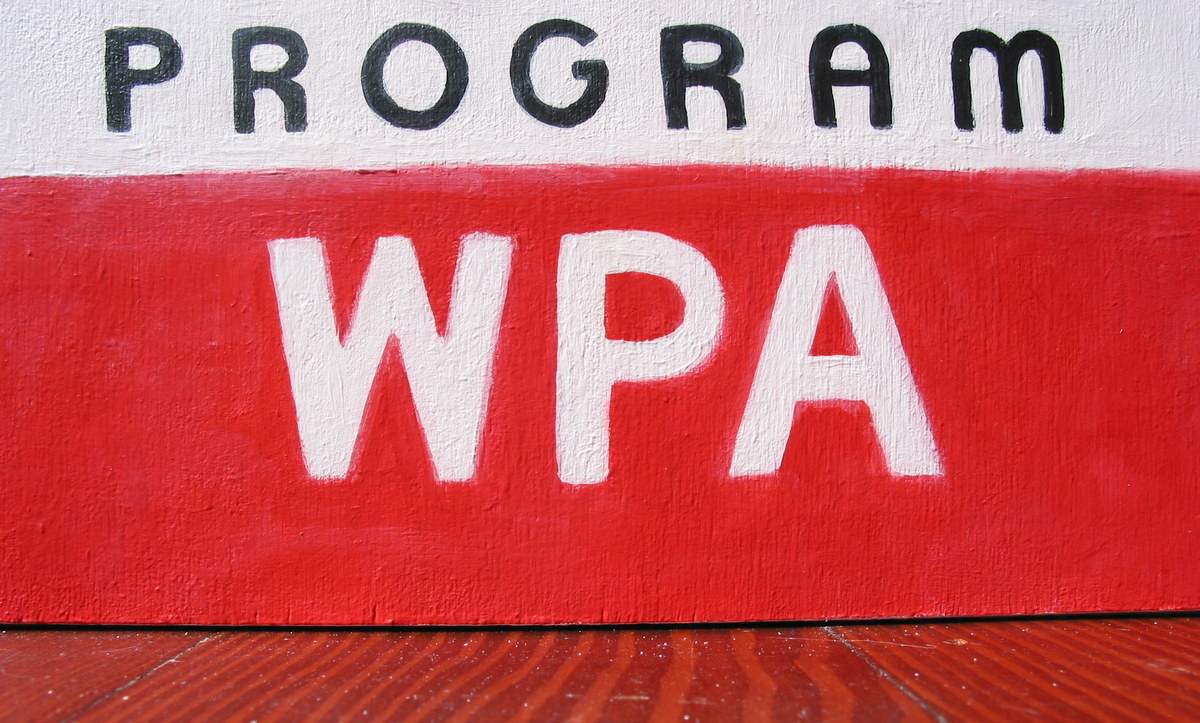
Last summer I unveiled six original paintings in a series called Dust Bowl Glimpses. Today, I am adding two more paintings to that series, "The WPA Promise" and "Security", and announcing a Buy One Get One FREE offer to celebrate their arrival.

"The WPA Promise" and "Security" are artistic renditions of symbols from government programs that provided relief to millions of Americans during the Great Depression, including migrant families displaced by the Dust Bowl. I wanted to include these symbols in the series because I believe they represent a time of healing and provide a continuation of the stories told in the original six paintings.

Because I think "The WPA Promise" and "Security" paintings would be best paired with one of the originals, I want to give them away to the next two buyers of my Dust Bowl Glimpses paintings on cradled wood panels. Yahoo!

How my BOGO offer works: 
  1. Purchase any of the remaining Dust Bowl Glimpses paintings (8"x8" acrylic on cradled wood panel) from my Etsy shop. Note: Purchases must be one of the 8"x8" original acrylic paintings on cradled wood panel.

    Here are the 5 remaining paintings at post time:
    Taking the Mother Road
    Waiting
    Worldly Possessions
    Fryin' Pone
    Ruthie's Red
    Faded Clover - SOLD
  2. Indicate your preference for the free painting, either "The WPA Promise" or "Security" in the "Note to weatheredsilo" field on the checkout screen. If the field is left blank, I will assume you do not have a preference and I will choose for you.
  3. I will send you a confirmation of your FREE painting via Etsy convo and email provided on your PayPal account.

Please note:
  • This offer expires once both free paintings have been awarded.
  • Awarding of the free paintings will be determined by the date/time of the buyer's purchase on a "first come, first serve" basis. In other words, the first buyer gets his/her first choice of free painting. If no preference of free painting is indicated in the "Note to weatheredsilo" field, then I will make the choice for him/her.
  • If one free painting is awarded then the remaining free painting will automatically go to the next buyer (based on the date/time of purchase)
  • If the first buyer purchases two paintings then he/she will receive both free paintings.

More about my new paintings: 

Just like the originals, "The WPA Promise" and "Security" are:
  • 8"x8"x1"
  • Acrylics on birch plywood cradled panel with protective UVLS polymer varnish topcoat
  • Washes of brewed coffee atop titanium white paint on sides
  • Wired for hanging (may sit on flat surface)
  • Titled and signed on back

"The WPA Promise" -- the story

The Works Project Administration (WPA) was the largest FDR New Deal agency. For eight years, the WPA employed millions of unskilled workers to carry out public work project, including buildings and roads, and operated large arts, drama, media and literacy projects. Visit here for more details. 


"Security" -- the story

The Farm Security Administration (FSA) was a part of FDR's New Deal. It was an effort during the Depression to combat American rural poverty. It stressed "rural rehabilitation" efforts to improve the lifestyle of sharecroppers, tenants, very poor landowning farmers, and a program to purchase submarginal land owned by poor farmers and resettle them in group farms on land more suitable for efficient farming. Visit here for more details.


Friday, May 18, 2012

for Clover


Faded Clover from my Dust Bowl Glimpses series

I recently had the joy of shipping my beloved "Faded Clover" to a little girl in San Francisco. The painting was a gift to Clover from her grammy and grandpa, Ema and Biggie, to celebrate her 1st birthday. 

I recognize how fortunate I am to know the back story of this purchase and I never want to forget what grammy Ema had to say about my artwork:
"I see this painting being part of a special series of stories for sweet Clover on many levels in addition to being a delightful display in her room. Your paintings draw me in and wanting to linger to consider their tales."
Thank you Ellen. I simply couldn't ask for a higher compliment. 


Saturday, December 17, 2011

taking the mother road -- the first story

NOTE: This post was originally published on August 29, 2011.

"Taking the Mother Road" - limited edition giclée print

Please allow me to share a story for each of the six paintings from my Dust Bowl Glimpses series, my first in some years now. They are dedicated to the impoverished people who, despite hardship, extended a hand to help strangers because it was the humane thing to do.

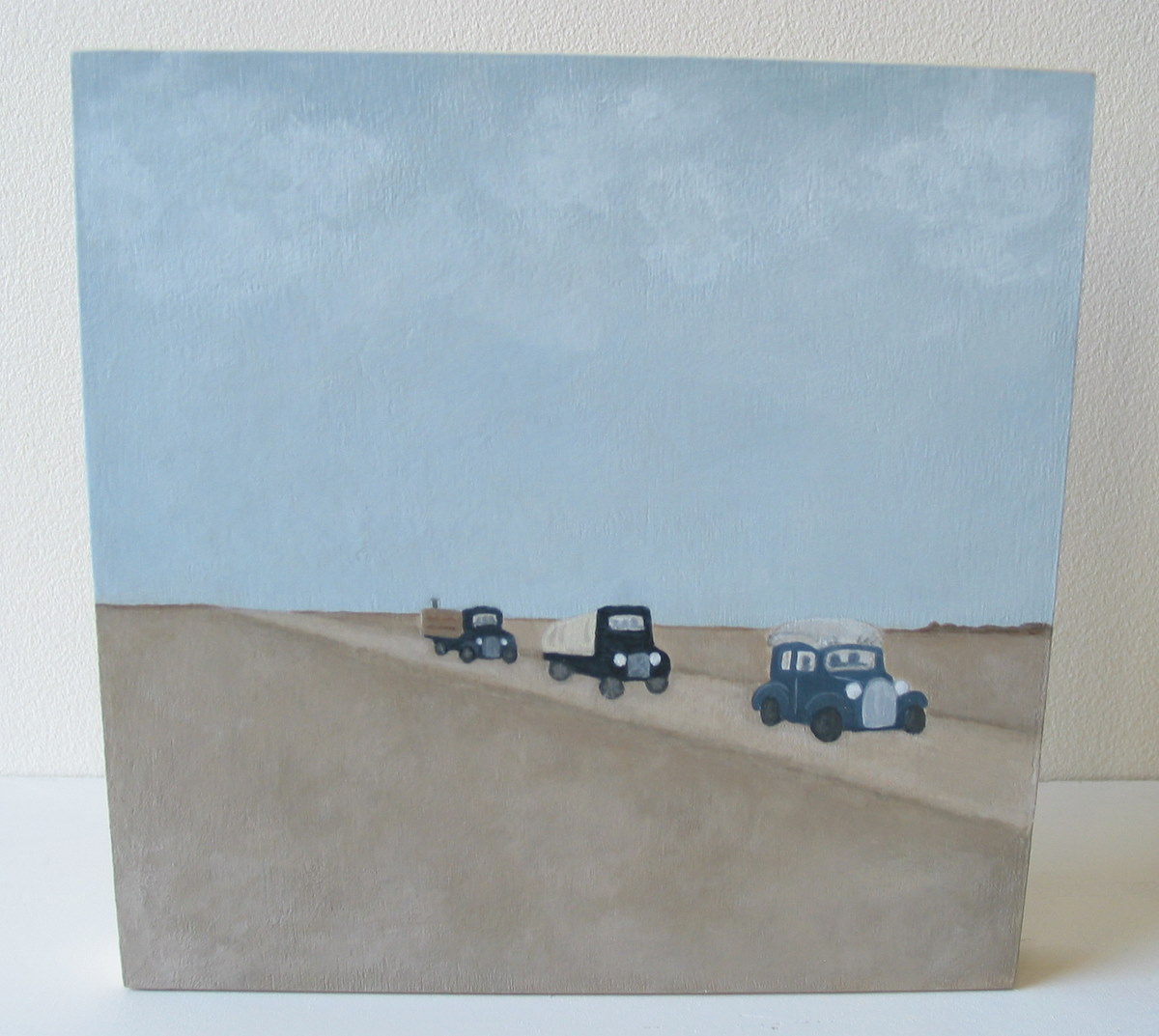
The first, "Taking the Mother Road", sets the stage for the remaining five:
They didn’t want to leave but they had no choice. Drought, dying livestock, foreclosures, and acres of topsoil blown into their homes and lungs drove them away from the only life they knew. California offered promises of steady work and fertile ground—a fresh start. They were taking the mother road.

"Taking the Mother Road" - 8"x8" acrylic on cradled wood panel


The colors are intentionally-muted. The landscape appropriately desolate. "Taking the Mother Road" attempts to capture the constant migration of families.

One by one, impoverished families of the Dust Bowl (1930s America) crawled onto Route 66, the mother road, in search of a better living out West. While some families stayed put, most could no longer endure the merciless conditions created by what would become a record-breaking 10-year drought, uncultivable land, and devastating winds that blew an estimated 100 million acres of topsoil across the region into homes, schools, and townships. One storm no dust bowler ever forgot was “Black Sunday”, a debilitating dust storm on April 14, 1935, that rolled across Kansas, Oklahoma, New Mexico, Colorado, and Texas.

My research on this project involved:
  • Reading John Steinbeck's Pulitzer-prize winning novel The Grapes of Wrath
  • Listening to my mom share stories of our ancestors who homesteaded on the prairies of Kansas and Colorado during the 1930s
  • Viewing PBS' American Experience (love their whole body of work) Surviving the Dust Bowl
  • Viewing the government-sponsored documentary released in 1936 The Plow that Broke the Plains
  • Visiting a variety of online sites
For those of you interested in learning more on the subject, I highly recommend watching the aforementioned videos. Interestingly, I chose not to watch the 20th Century Fox movie version of The Grapes of Wrath for fear of being influenced by the images. Not sure why I thought that, but I did. The Oscar-winning movie is now in my Netflix queue.

~~~~~~~~~~~~~~~~~~~~~~~~~~~~~~~~~~~~
Click here to read the stories on the remaining five DUST BOWL GLIMPSES paintings. Galleries have also been added to my Web site: www.weatheredsilo.com.

Thursday, September 15, 2011

Yale database of Depression-era photographs

"Taking the Mother Road" - DUST BOWL GLIMPSES series


Today I learned something that literally gave me goosebumps! Thanks to a $50,000 National Endowment for the Humanities grant, Yale Professor Laura Wexler and her team will "construct an innovative online archive of government-owned photographs taken during the Great Depression....with server capacity to support the 160,000 images in the archive of the United States Office of Digital Humanities." Simply extraordinary!

"The website will eventually benefit researchers, historians and students as young as middle-schoolers, Wexler said. The digital humanities widen what were previously areas of rarified scholarship, she said — rather than simply providing academics and students the raw photographs, tools such as the geographic overlay and corresponding census data kick-start engagement with the material."

As you know, this subject is near and dear to my heart. I spent the past year researching and working on my new Dust Bowl Glimpses paintings, scouring library shelves, Web sites, and more. My daughters joined me on this journey, and to think they will have access to an even-richer historical experience brings me great joy--I cannot wait.

For more on the Yale project, please follow this link to Eliza Brooke's story in today's Yale Daily News, Government Photos Take New Form Online .

Saturday, September 3, 2011

faded clover - the sixth story


She never knew the likes of a store-bought dress. Neither did her three older sisters. Each migrant daughter wore clothes hand sewn by their mother, often times made from grain sacks. Her favorite was this clover-patterned number.


My mom's mom, Viola Davis, was born in 1926 in Hoxie, Kansas. Grandma was one of five children growing up in a small town on the northeastern plains Kansas during the Great Depression. She, like her siblings and so many children of that time, wore clothes beautifully hand sewn from flour and grain sacks--the inspiration for my painting.

Mom tells me how much my grandma adored the flour sack dresses her mom made. The clover-patterned number in my painting was a pattern I fell in love with during my research on the history of flour sack dresses. I like to believe that my grandma would approve of this painting.

Here is a photograph of my grandma, Viola Davis, in the early 1930s alongside two schoolmates. She is wearing one of the flour-sack dresses her mom made. I think she looks absolutely beautiful!


My grandma, Viola Davis, and schoolmates in the early 1930s - Hoxie, KS


Thank you for allowing me to share stories about my Dust Bowl Glimpses paintings. Working on this collection has truly been a labor of love.

Cheers, Mandy

Friday, September 2, 2011

ruthie's red -- the fifth story


The colors of young Ruthie Joad’s world ranged from faded denims and soiled flesh to endless hues of brown. But that all changed when the rains finally came. The landscape was now littered with lush greens and vivid wildflowers. Ruthie grew particularly fond of red geraniums. They were now known as "Ruthie’s Red".


The moment I read how Ruthie Joad from The Grapes of Wrath stuck a petal from a "scraggly geranium gone wild" to her forehead because it resembled a heart, I knew I had to try and capture her euphoria on canvas. To me, this moment was not just a reprieve but also an escape to absolute normalcy for a child her age.


"Ruthie's Red" - 8"x8" acrylic on cradled wood panel


Tomorrow I will share a story of "Faded Clover", my sixth and final painting in my Dust Bowl Glimpses series. In case you missed them, here are stories one, two, three, and four. As always, thanks for stopping by. Cheers, Mandy

Thursday, September 1, 2011

fryin' pone -- the fourth story


This morning brought a welcome respite. The family awoke to the clattering of pans and the comforting aroma of ma’s homemade corn pone. Were they still dreaming, they wondered. Yesterday the men earned nearly a dollar pickin’ so ma could splurge on cornmeal and bacon at the camp store. Fryin’ pone made her feel decent again.


"Fyin' Pone" -- 8"x8" acrylic on cradled wood panel


Packing up and leaving everything you know must have been petrifying for so many families on the road, especially the parents. Just imagine the strength it took to for mothers to carry on as if everything was going to be fine when in fact the future was uncertain. Thankfully there were moments where life resembled a time before the dust storms came. Moments like this where a mother could provide for her family. A moment when she could feel useful once again.

Thank you for following along as I share stories of my Dust Bowl Glimpses paintings. Here are links to stories one, two, and three of six.

And, before I forget, I wanted to make special mention of the stunning frame pictured with my giclées. It is beautifully handcrafted from olde growth pine by Margaux + Walter Kent of Peg+Awl. I couldn't imagine a more perfect pairing.

Cheers, Mandy

Wednesday, August 31, 2011

worldly possessions -- the third story

"Worldly Possessions" - Limited Edition Giclée Print

A mattress, some dishes, a stove if you were lucky enough to own one, definitely the tarpaulins, and maybe a chair or two. That was all they had room for on the truck besides the family. When you are a migrant family, these become your worldly possessions.

"Worldly Possessions" - 8" x 8" acrylic on cradled wood panel


I knew almost immediately that I wanted to paint this image. To me, the sheer lack of belongings depicted in photograph after photograph of makeshift roadside camps spoke volumes about the plight of the migrant families. I hope you find beauty in the simplicity as much as I do.

Here are stories one and two of my Dust Bowl Glimpses paintings. As always, thank you for stopping by.

Mandy

Tuesday, August 30, 2011

waiting -- the second story


They’d driven as far as a dollar of gas could take them. Now they waited. Waited under the merciless sun with hungry bellies and soiled clothing. They waited for news of work in the fields as promised on government handbills distributed just weeks prior. They waited for a time when they were migrants no longer. Waiting was all they could do.


As a mother, I cannot imagine how difficult it must have been to raise a family under such dire conditions -- it certainly makes me appreciate the community, family, and home that I have today.

Part of my research for this painting involved tracking down the goods originally shipped in the cardboard box that Florence Owens Thompson sat on in Dorothea Lange's iconic Great Depression photograph, "Migrant Mother". Taking what little print I could see on the box, I finally tracked down this June 21, 1919 price list from Swift & Co. of their canned fish offerings (below). Don't you just love it?!


Link
In case you missed it, here is the story of my first Dust Bowl Glimpses painting, "Taking the Mother Road". As always, thanks for stopping by. Cheers, Mandy

Friday, August 26, 2011

Dust Bowl Glimpses revealed


"Taking the Mother Road" - acrylic on cradled wood panel

I am beyond thrilled to finally be revealing my Dust Bowl Glimpses series of original paintings and limited edition giclée prints. I've only been working on this labor of love now for 12 months!!


"Waiting" - acrylic on cradled wood panel


"Worldly Possessions" - acrylic on cradled wood panel


The idea for this series, my first in some years now, came to me last summer after reading John Steinbeck’s Pulitzer-prize winning novel, The Grapes of Wrath, and helping my mother digitize a photo collection of her ancestors who homesteaded on the prairies of Kansas and Colorado in the early 1900s. I came away from both experiences with a much greater understanding of the human condition during the Great Depression, specifically of those families displaced by the Dust Bowl.


"Fryin' Pone" - acrylic on cradled wood panel


"Ruthie's Red" - acrylic on cradled wood panel


My paintings are dedicated to the impoverished people who, despite hardship, extended a hand to help strangers because it was the human thing to do.


"Faded Clover" - acrylic on cradled wood panel


Over the next few days I will be blogging about the stories behind each of the six original acrylic paintings on cradled birch wood panels as well as details about my professionally-printed fine art giclées.

But for now, given how late it is on a Friday afternoon, I simply invite you to visit my Etsy shop to browse the entire collection. Perhaps you'll fancy something for yourself or a loved one.

Thank you...and special thanks to each and every one of you who supported me during this journey -- I am forever grateful for your inspiration and guidance.

Cheers, Mandy

Tuesday, August 23, 2011

scumbling along


Earlier this year when I became too impatient for my oil paints to dry, I opted for acrylics (a medium I didn't have much experience with) to create my new Dust Bowl Glimpses paintings. And while I enjoyed how fast I was able to transfer my ideas to canvas using the acrylics, I was frustrated at how fast they dried.

I realize that there are products that can be mixed with acrylics to lengthen their drying times, but I wasn't interested in that option. So I began experimenting with acrylics and stumbled upon a painting technique called "scumbling".

What is scumbling? It involves applying a thin layer of opaque or semi-opaque paint over a layer of different color of paint. Scumbling may be achieved by scraping, scrubbing or dragging a layer of paint over a dark underpainting, resulting in a hazy, opalescent effect. Scumbling allows artists to create smooth transitions from light to dark and to modify the original color of the overlaid area without completely concealing it.


Here I'm dragging a rather thick layer of raw sienna acrylic paint over a dried layer of paint.


Here is the result. I LOVE it!


Here's a sneak peek at how I used scumbling on my "Fryin' Pone" painting that will be available for sale in my Etsy shop later this week alongside five other Dust Bowl Glimpses paintings. I'm thrilled to have turned a frustration into an opportunity. Cheers!


Here I've scumbled a darker gray acrylic over a lighter gray to create depth on the metal spoon in my "Fryin' Pone" Dust Bowl Glimpses painting. I also scumbled a layer of deeper yellow ochre atop a dried lighter shade.


Full view of "Fryin' Pone".